Proposal for full-time engagement
Contents
{{ crumb }}
The position

Director of
Business Strategy
& Innovation

Robert T. Hunter
The purpose of the position
To increase the probability that every business the firm supports becomes more valuable than it otherwise would have been.
The offer in four numbers
{{ num.v }}
{{ num.k }}
{{ num.d }}
If you read nothing else
{{ t.n }}
{{ t.head }}
{{ t.body }}
§{{ t.ref }}
The engagement at a glance
{{ g.k }}
{{ g.v }}
What the decision actually risks
Firm's exposure
$36,000
Total compensation across the 90-day validation period, after which either party may stop.
Value target
~$72,000
Created, identified or protected over the same period, documented in four separate categories.
The detail, in eight sections
The full proposal runs twenty-two pages. What follows is the same substance, each section built around one diagram — open any one for the reasoning behind it.
{{ progressLabel }}
Section 01

The Gap

Capital gives a company resources. It does not automatically give the company clarity.

Who sees how much of the business
Tap
{{ g.title }}
The whole
Unowned
{{ gapBlind }}
Problems rarely stay in one department
{{ x.a }}
MAY BE
{{ x.b }}
Section 02

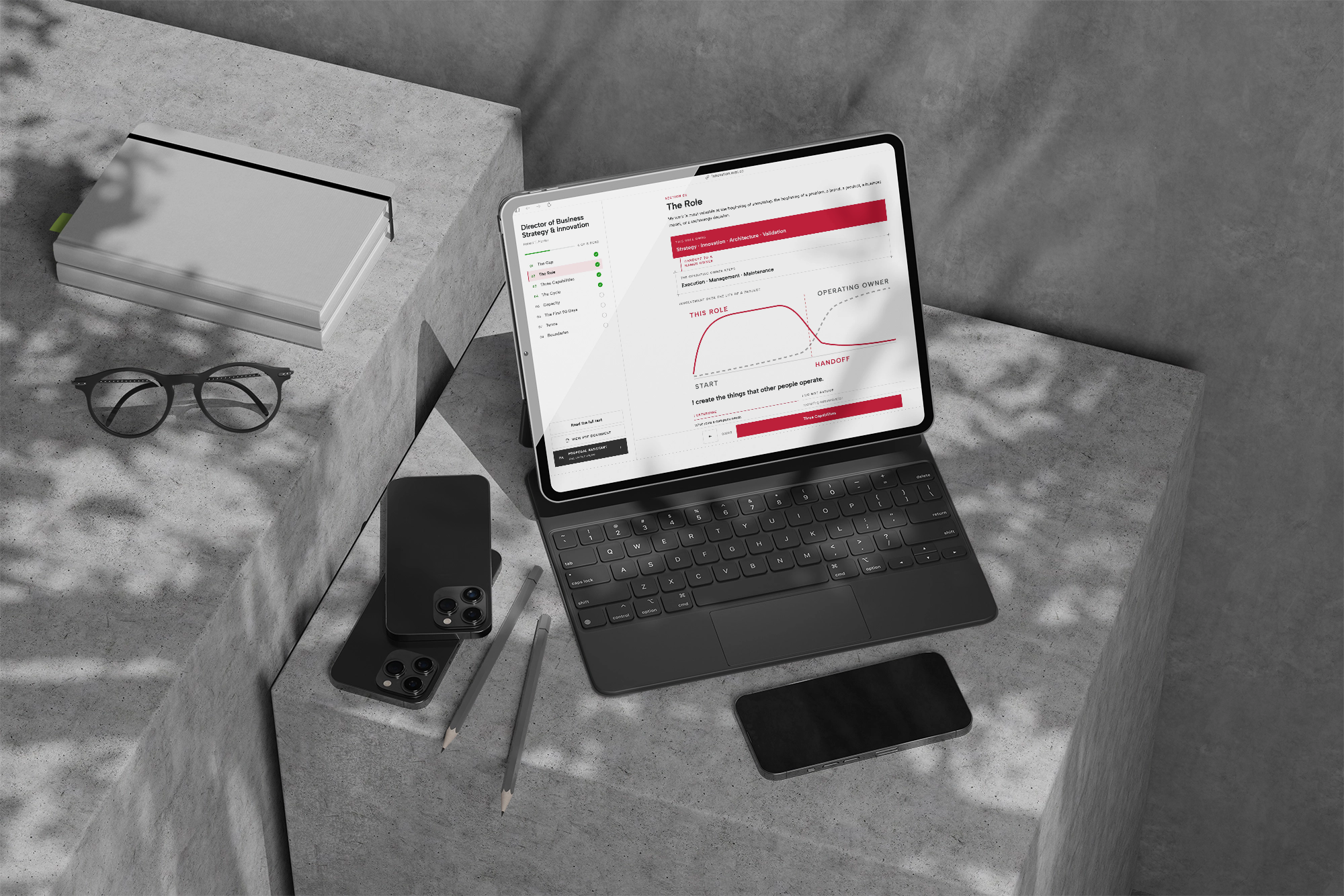
The Role

My work is most valuable at the beginning of something: the beginning of a problem, a brand, a product, a business model, or a technology decision.

This role owns
Strategy · Innovation · Architecture · Validation
Handoff to a
named owner
The operating owner keeps
Execution · Management · Maintenance
Involvement over the life of a project
THIS ROLE OPERATING OWNER HANDOFF START
I create the things that other people operate.

Once the right answer has been identified, designed, validated, documented, and transferred to a capable owner, I move forward. That is not a limitation. It is the design of the role.

I determine
{{ d }}
I do not assume
{{ d }}
Section 03

Three Capabilities

Tap any capability to open it.

{{ c.n }}
{{ c.title }}
{{ c.sign }}

{{ c.lede }}

{{ c.listLabel }}
{{ p }}
{{ t }}
{{ c.bottom }}
Section 04

The Cycle

Every major assignment moves through the same seven steps. Learn. Diagnose. Architect. Validate. Transfer. Move forward.

{{ st.n }}
{{ st.title }}
{{ st.body }}
The output must be specific enough that another person or team can execute it. Every major assignment should leave the company with something durable.
Section 05

Capacity

This work requires enough focus to understand the actual situation rather than reacting to its visible surface.

Primary
Highest-priority strategic or innovation challenge
Secondary
Follow-up, smaller scope, or firm-level initiative
Normal working capacity, plus reasonable availability for time-sensitive matters designated as priorities by the firm.
The number of companies in the portfolio does not determine the workload.
One company may require a concentrated six-week engagement while several others need only limited strategic input during the same period.
Priorities route through one person
{{ f }}
One firm-level decision-maker
That protects the position from becoming a fragmented collection of competing requests.
What the firm can expect
{{ r.when }} {{ r.what }}
I will not use activity as a substitute for progress.
What I need from the firm
{{ n }}
I can create clarity inside complicated situations. I cannot do so without honest access, reliable information, and someone prepared to act on the result.
Section 06

The First 90 Days

A mutual validation period. It should establish clearly whether the position creates enough visible value to justify a long-term relationship.

{{ p.range }}
{{ phaseTitle }}
{{ i }}
Personal target for the validation period
~$72,000
in defensible value created, identified, or protected — approximately twice the compensation paid during the period. A performance target, not a contractual guarantee of cash revenue.
Value is reported in four separate categories
BankedProjected
{{ v.n }}
{{ v.title }}
{{ v.body }}
These categories are not financially interchangeable, and the monthly report will not present them as though they were.
Section 07

Terms

Full-time employment. $12,000 monthly through year one, $15,000 monthly thereafter, with a review at day 90.

$12,000
$15,000
Months 1–12
Per month for the first twelve months. $144,000 annualized.
Month 13 onward
Per month thereafter. $180,000 annual salary.
Acceptance of the initial compensation is not a permanent repricing of the role. It is a practical accommodation for the first twelve months while the function is being established and proven.
Initial appointment — year one
90-day review
Mutual validation point
Nine months at $12,000 monthly
If both parties elect to continue. $15,000 monthly from month 13.
Schedule
Full-time, normally 40 to 50 hours weekly, with reasonable executive discretion over how that time is allocated. Compensation is not tied to the number of portfolio companies — the role is governed by prioritized work capacity.
Section 08

Boundaries

These boundaries are not designed to limit my contribution. They are designed to protect the function the firm is hiring me to perform.

The role includes
Does not include
{{ scopeMark }}{{ s }}
Oxford Pierpont infrastructure
Optional. Never a condition of employment.
A separate vendor relationship under its own written agreement. I will disclose my ownership interest whenever I recommend one of its services, and the firm remains free to evaluate alternatives.
{{ o.t }}
{{ o.d }}
Third-party consumables are passed through at the amount billed, without markup. Development, migration, implementation, administration and support are scoped and priced separately before work begins.
Excluded from this employment
×{{ e }}
I may present independently owned ventures to the firm for possible investment or partnership. The firm has no obligation to proceed, and presenting one creates no ownership or economic rights — those arise only through a separate written agreement.
The takeaway
{{ takeaway.head }}
{{ takeaway.tag }}
{{ takeaway.body }}
Closing

Where this leaves us

The fit is not another executive to manage one function indefinitely. It is someone who can enter unfamiliar situations quickly, identify what has been missed, determine what should happen next, and create the architecture that allows the right execution to follow.

This proposal gives the firm a practical way to test that thesis with limited initial risk. By the end of the first 90 days, both parties should have enough evidence to make an informed decision about what comes next.

Your response
{{ d.title }}
{{ d.body }}
{{ decisionAck }}
Robert T. Hunter
Candidate for Director of Business Strategy & Innovation
View PDF document
Full text

The Proposal

Sixteen sections in four parts. Every section shows its conclusion first — open one only where you want the reasoning.

{{ toggleAllLabel }}
{{ openCountLabel }}
{{ grp.letter }}
Part {{ grp.letter }} · {{ grp.range }}
{{ grp.title }}
{{ r.n }}
{{ r.title }}
{{ r.takeaway }}
{{ r.sign }}
{{ b.text }}

{{ b.text }}

{{ b.text }}
{{ b.mark }} {{ it.lead }}{{ it.text }}
{{ it.k }}
{{ it.v }}
{{ it.label }}
{{ it.value }}
{{ b.leftLabel }}
{{ l }}
{{ b.rightLabel }}
{{ l }}
{{ c }}
{{ b.value }}
{{ b.text }}
{{ b.text }} →
{{ startLabel }}
{{ pagerLabel }}
{{ nextLabel }}